

 Bukola Arikawe
They say that in a relationship, ego is like the unwanted guest that always seems to show up unannounced. It has a way of demanding attention, asserting its importance, and causing all sorts of mischief.
But if we’re honest with ourselves, virtually everyone has been guilty of letting ego take the stage at times. We’ve seen how it can cast a shadow over love, creating distance and conflict where there should be warmth and understanding.
But what if we flipped the script? What if we embraced empathy instead of letting ego run the show?
Imagine a romantic relationship where partners prioritize understanding, compassion, and selflessness.
A connection where the needs of both individuals are acknowledged and respected and where the delicate balance between ego and empathy is carefully navigated.
This piece on navigating the thin line between ego and empathy in your relationship will show you how to turn this imagination into reality in your romantic relationship or in that of someone you know.
Enjoy!
Pay Attention to Your Partner’s Feelings and Needs

Being attentive to your partner’s feelings and needs is like mastering the art of reading between the lines. It’s about going beyond the surface-level interactions and truly tuning in to the unspoken cues and emotions that lie beneath.
It’s a superpower that allows you to create a safe space where your partner feels seen, heard, and valued.
Now, let’s be real for a moment. As humans, we’re bound to have moments of distraction or self-absorption.
But the beauty lies in our ability to recognize those moments and make a conscious effort to be present for our partners. It’s a skill that can be honed and nurtured over time.
So, how can you achieve this level of presence? Start by practising active listening. Put down your phone, turn off the TV, and truly engage with your partner when they speak.
Maintain eye contact, nod in understanding, and offer words of affirmation. Show genuine curiosity about their experiences, thoughts, and feelings.
Let them know that you are fully present, ready to listen without judgment or interruption.
Reflect on Your Own Ego-Driven Behaviors and Triggers
It sounds like a daunting task, right? But the thing is, self-reflection is like looking into a magical mirror that reveals the hidden depths of your own ego.
It’s not about beating yourself up or pointing fingers but rather about embracing the opportunity to grow and evolve.
Acknowledging and understanding these triggers can give you the power to steer away from ego-driven behaviours.
It’s like finding the emergency brake just in time to prevent a relationship collision.
However, note that reflecting on your own ego-driven behaviours and triggers is not about achieving perfection or eradicating ego entirely.
Rather, by shining a light on those triggers, by being aware of their presence, you gain the power to navigate that thin line between ego and empathy.
Take Responsibility for Your Actions

Taking responsibility for your actions is like stepping onto a tightrope in the circus of relationships. It requires balance, vulnerability, and a willingness to admit when you’ve made a misstep.
It means recognizing that your words and behaviours have an impact that may not always align with your intentions.
I know owning up to our mistakes is not always easy. It can feel uncomfortable and expose our vulnerabilities.
But when we choose to take responsibility, something remarkable happens. We begin to break down the walls of ego and create an environment where empathy can flourish.
Taking responsibility means acknowledging your role in a situation without shifting blame onto others.
It means saying, “I messed up, and I’m sorry”, instead of pointing fingers and deflecting accountability. It’s about recognizing that your actions have consequences and actively working to repair any harm caused.
Bear in mind that taking responsibility goes beyond just offering an apology. It’s making a genuine effort to learn from your mistakes and make positive changes moving forward.
It’s about taking the lessons you’ve learned and applying them to become a better partner, a better communicator, and a better human being.
Foster Open and Honest Communication

Building a foundation of open and honest communication is like creating a bridge between ego and empathy, allowing understanding and connection to flow freely.
It starts with a deep breath and a willingness to be vulnerable.
You take the first step, expressing your feelings without blame or judgment. And you know what happens next? Your partner responds with the same level of openness and honesty.
It’s an open secret that honest communication isn’t always easy. It can be messy, uncomfortable, and even scary at times.
But a thing to etch in your mind is that it’s worth it.
When you create a safe space for open dialogue, you invite empathy to take the stage. You give your partner the opportunity to truly understand your perspective and vice versa.
Moreso another vital thing to note is that open and honest communication requires practice. It’s like learning to ride a bicycle. You may stumble and fall a few times, but each fall teaches you something new.
It’s about finding the right balance between speaking your truth and listening with an open heart.
Put Yourself in Your Partner’s Shoes
Putting yourself in your partner’s shoes is like slipping on a pair of empathy sneakers.
It’s about stepping out of your own perspective and experiencing the world through their eyes.
It’s an act of compassion that allows you to better understand their emotions, challenges, and desires.
Although putting yourself in someone else’s shoes is not always a walk in the park. It requires you to let go of your preconceived notions, biases, and judgments.
It means temporarily setting aside your own experiences and opening yourself up to truly see the world from your partner’s vantage point.
But the beauty of empathy is that it has the power to bridge the gap between you and your partner.
It creates a bridge of understanding and connection that transcends the walls of ego and leads to a deeper level of intimacy and harmony.
To achieve this level of empathy, it’s important to actively listen and observe. Pay attention to your partner’s verbal and nonverbal cues. Try to imagine what it feels like to walk in their shoes, experiencing the world as they do.
Practice Humility
Practising humility can be regarded as the art of swallowing your pride and embracing a humble mindset.
It may sound like a tall order, but let me assure you, it’s a game-changer in navigating the thin line between ego and empathy in your relationship.
Practising humility is like opening a window in a stuffy room.
It allows fresh air to enter, clearing away the stubborn fog of ego.
It’s about embracing the notion that you don’t always have to be right and that your partner’s ideas and opinions are just as valid as yours.
Practising humility is not about being weak or submissive but about recognizing that there is strength in vulnerability and power in acknowledging the limits of your own knowledge.
It’s like having the humility to ask for directions when you’re lost rather than stubbornly insisting that you know the way.
Strive to Find Mutually Beneficial Solutions
Finding mutually beneficial solutions is like finding that sweet spot where both partners feel heard, valued, and satisfied.
It’s a game of give and take, where ego takes a backseat, and empathy takes the lead. It’s about moving away from a win-lose mentality and embracing a win-win mindset.
It’s an opportunity to come together, explore creative possibilities, and find a middle ground where both of your needs are met.
So, how do you achieve this delicate balance of compromise? Start by fostering open and honest communication.
Share your thoughts, concerns, and desires with your partner, and encourage them to do the same. Listen actively and strive to understand each other’s perspectives.
When conflicts arise, resist the urge to dig your heels in and defend your position at all costs.
Instead, adopt a curious mindset and explore alternative solutions together.
Brainstorm, brainstorm, brainstorm!
Get creative and think outside the box on ways to meet each other halfway. Sometimes, it’s a matter of prioritizing what truly matters and letting go of the rest.
Develop Emotional Intelligence
Developing emotional intelligence is like adding vibrant colours to the canvas of your relationship, bringing depth and richness to your connection.
Developing emotional intelligence is like fine-tuning an instrument. It’s about becoming aware of your own emotional landscape, recognizing triggers and patterns, and learning to navigate them with grace.
It’s also about tuning in to your partner’s emotions, listening not just with your ears but with your heart.
It isn’t about achieving perfection or suppressing your own emotions. It’s about embracing the messy beauty of human emotions and using that understanding to navigate the thin line between ego and empathy.
It’s like learning the delicate dance of emotions, where each step is guided by empathy and compassion.
So, how do you develop emotional intelligence? Start by tuning in to your own emotions, being curious about them, and learning to express them in healthy ways.
Practice Appreciation and Gratitude
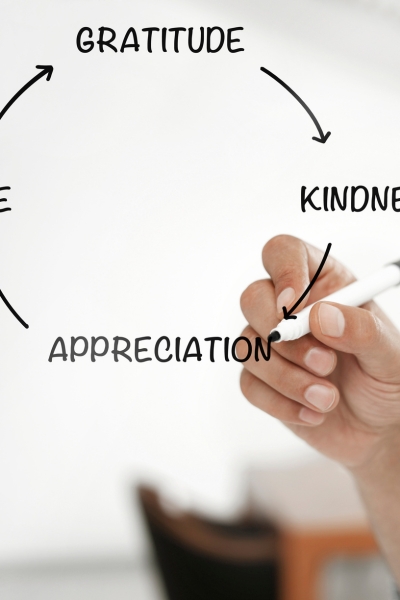
Practising appreciation and gratitude is like sprinkling magical fairy dust on your relationship—it has the power to transform ordinary moments into extraordinary ones.
Life can get hectic, and it’s easy to take things for granted.
But when you make a conscious effort to appreciate and express gratitude for your partner and the relationship you share, something beautiful happens.
You begin to see the world through a different lens—a lens of appreciation, love, and admiration.
Practising appreciation is not just about saying a quick “thank you” or giving a polite nod—it goes deeper.
It’s recognizing and acknowledging your partner’s efforts, qualities, and actions that make your relationship special. It’s about expressing genuine gratitude for their presence in your life.
So, take a moment to reflect on the things you appreciate about your partner. Think about the small and grand gestures that have made a positive impact on your relationship.
Now, don’t keep those thoughts to yourself!
Express your appreciation and gratitude openly and sincerely. Tell your partner how much you value and cherish them.
It can be a heartfelt conversation, a handwritten note, or even a random text message to brighten their day.
Trust me, the power of appreciation and gratitude is contagious—it creates a positive ripple effect within your relationship.
Avoid Comparison
Comparison is that sneaky trap that can sabotage even the strongest of relationships.
Avoiding comparison is like removing a foggy lens through which you view your relationship, allowing clarity and appreciation to shine through.
You shift your focus inward rather than looking outward and measuring your relationship with others. You celebrate the uniqueness of your own journey, appreciating the small moments of joy and growth that make your relationship special.
Nonetheless, it’s not about the grand gestures or the extravagant displays of affection. It’s about the genuine love and connection that exists between you and your partner.
Avoiding comparison isn’t about striving for perfection or measuring up to an unrealistic standard.
No. It’s about embracing the imperfections and quirks that make your relationship uniquely yours. It’s like accepting that your relationship is a beautiful work in progress, constantly evolving and growing.
Prioritize Self-Care and Self-Compassion

I know what you might be thinking. Isn’t a relationship all about the other person?
Well, the secret is that it starts with you.
Prioritizing self-care and self-compassion means recognizing that you are an essential part of the equation. It requires nurturing the relationship with yourself so that you can show up as your best self in your relationship.
Consider when you take care of yourself—physically, emotionally, and mentally—you have more to give to your partner.
It’s like recharging your batteries. You fill up your cup, and then you have an overflow of love, energy, and kindness to share with your significant other.
Self-care can take many forms—it’s about finding what works for you, giving yourself permission to prioritize your well-being and recharge your batteries.
Let’s not forget about self-compassion. It’s the art of treating yourself with kindness, understanding, and forgiveness.
We all make mistakes, have flaws, and go through challenging times. Instead of beating yourself up, embrace self-compassion.
Offer yourself the same understanding and support you would give to a dear friend.
Regularly Seek Feedback
Seeking feedback is like adding a GPS to your relationship journey, helping you navigate the twists and turns with clarity and intention.
Regularly seeking feedback nourishes your relationship, allowing it to thrive and grow. It takes being curious and genuinely interested in understanding your partner’s perspective.
It also refers to being willing to receive feedback, recognizing that there is always room for improvement and growth.
Keep in mind that seeking feedback in your relationship isn’t about seeking validation or proving who’s right or wrong.
It’s about fostering a safe space for open and honest communication. It’s like having a co-pilot in your relationship journey, where both of you have a say in the direction you’re heading.
Drawing the Curtain
As we draw the curtain on this exploration of navigating the thin line between ego and empathy in your relationship, I hope you’ve found some valuable insights and practical strategies to take with you.
Remember, relationships are like delicate routines requiring balance, communication, and a willingness to step into each other’s shoes.
I encourage you to take the ideas shared in this post and put them into action.
Start small, with little acts of empathy and appreciation. Notice the positive shifts in your connection, the smiles that linger a little longer, and the warmth that fills the spaces between you.
And hey, if you have a story or experience to share, don’t hesitate to drop a comment below.
Thank you for joining me on this adventure on how to navigate the thin line between ego and empathy in your relationship.